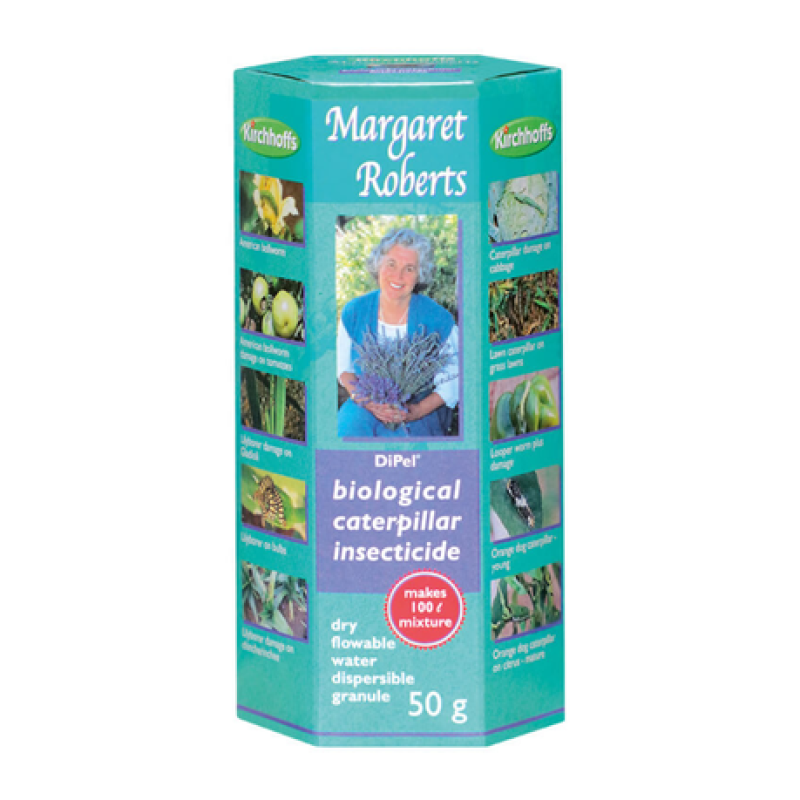
Margaret Roberts Biological Caterpillar Insecticide - Kirchhoff's (50g)
- Brand: Kirchhoffs
- Product Code: 90491875
- Availability: 25
-
R289.00
Margaret Roberts Biological Caterpillar Insecticide by Kirchhoffs | 50g.
This is a biological insecticide for leaf-eating caterpillars in the home garden. The active ingredient is Bacillus thuringiensis var. kurstaki (32 000 IU/mg). Young caterpillars eat sprayed leaves, stop feeding within about a day, then die and drop off in 3–4 days (longer in cold weather).
It is not a broad-spectrum poison. It targets larvae of moths and butterflies that chew leaves. Bees, birds, fish, pets, wildlife and most beneficial insects are not the target. It can harm young butterfly caterpillars, so do not spray plants that adult butterflies are using for eggs.
Edible crops may be harvested after application according to the pack. Wash produce before eating. Handle the granules with care: they can irritate skin and eyes. Keep out of reach of children and animals.
What you can use it on:
Pests listed on the product: American bollworm, lily borer, diamond-back moth caterpillar, semi-looper (Plusia), leafroller, lawn caterpillar. Other retailers also list lucerne caterpillar and pine tree emperor moth larvae among leaf-eating Lepidoptera.
Crops and plants listed: vegetables, fruit, flowers, bulbs, lawns, herbs and cannabis. Typical home-garden uses include cabbage and other brassicas, tomatoes, roses, clivias and lilies, lawn patches chewed by lawn caterpillar, and leafy herbs.
It only works if the caterpillar eats treated foliage. Spray both sides of leaves while larvae are small and still feeding. It will not knock down adult moths or butterflies on contact.
Frequently Asked Questions
- What is Margaret Roberts Biological Caterpillar Insecticide?
A 50g water-dispersible biological insecticide from Kirchhoffs. It contains Bacillus thuringiensis var. kurstaki and is used on young leaf-eating caterpillars in the home garden. Registration number L7112 (Act 36 of 1947). - Which plants can I spray it on?
Vegetables, fruit, flowers, bulbs, lawns, herbs and cannabis, as listed on the pack. It is commonly used on brassicas, tomatoes, roses, lilies/clivias and chewed lawn. - How does it kill caterpillars?
Caterpillars eat treated leaves and stop feeding within a day or so. They often hang on the plant, then rot and drop within 3–4 days. Cold weather slows this down. Adult moths and butterflies are not killed. - Is it safe for bees, pets and edible crops?
The product is described as harmless to bees, birds, fish, pets, wildlife and beneficial insects, with no secondary poisoning. It can harm young butterfly larvae, so avoid plants butterflies are using. Edible crops may be harvested after application; wash food before eating. Follow the label. - Will it work on aphids, snails or adult moths?
No. It only works against leaf-eating caterpillar larvae that ingest the spray. Use a different registered product for sucking pests, slugs or adult insects.